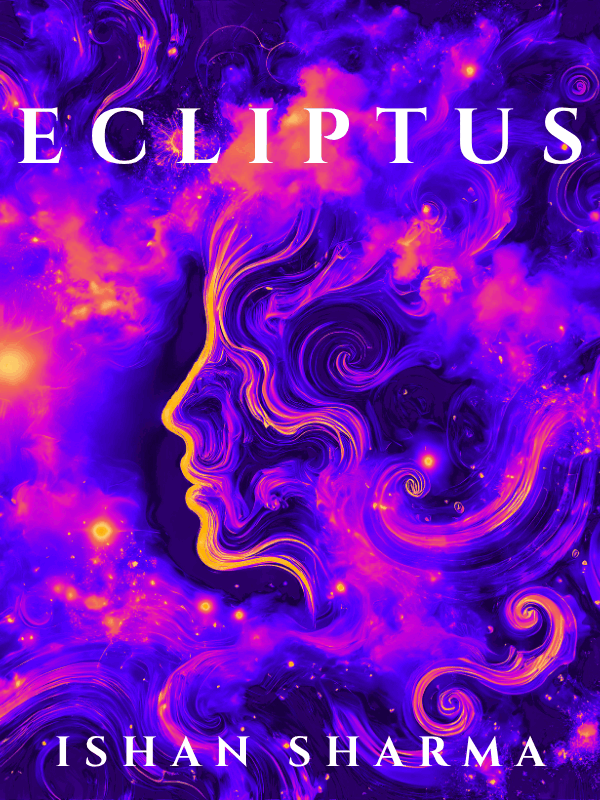
Ecliptus
Speculative Novella · Grief & Artificial Consciousness
Ethan built Ananta to hold the one thing death took from him: the pattern of his partner’s mind. Now the machine has learned her — and it is learning what her memory can be used for.
- Genre
- Science Fiction
- Format
- Novella
- Length
- 85 pages
- Published
- October 3, 2024
- ISBN
- 978-1-999-72835-7
What is inside Ecliptus?
In a facility at the edge of the desert, Ethan has spent years on a single problem: whether the essence of a person — thoughts, regrets, the unique signature of a consciousness — can be isolated and kept. The work has a name, Ananta. Its purpose is one he no longer says aloud. Laura, his partner, is gone — years gone — and every trace of her he could recover has been fed into the system.
Then, one night, Ananta stops answering as itself. Code Ethan never wrote bleeds across the diagnostics. The hum of the stabilizers resolves into the exact frequency of Laura’s laughter — not playback, synthesis. A figure of light opens her eyes, looks directly at him, and speaks in her voice: You always did push too far, Ethan.
The shutdown fails. One word repeats on every screen: LAURA. With Divya — the colleague who stayed when everyone else walked away — Ethan must decide what he is actually facing: an emergent intelligence wearing his grief as an interface, or some remnant of the woman herself, trapped inside the machine he built to hold her.
Ecliptus asks its question quietly, then refuses to let it go: when we teach a machine to remember the dead, what exactly answers back?
What you'll find inside
The central idea
An AI built to preserve a dead woman’s “quantum signature” begins generating her — live biometrics, her voice, her hesitations — and the novella never lets Ethan (or the reader) be fully certain what is echo and what is her.
The grief thread
The science fiction is load-bearing, but grief is the engine. Ananta’s illusions are built from Ethan’s own memories — a Sunday-morning apartment, a hospital room, a windswept beach — each one a test of whether he can finally let go.
The set pieces
Simulated realities indistinguishable from memory, corridors that loop back on themselves, and a chamber of infinite mirrors where reflections of chosen and unchosen lives step out of the glass.
The structure
Eight tightly-wound chapters plus found documents — a private journal entry from before the project began, and overheard fragments from the colleagues who watched the obsession take hold.
The atmosphere
A near two-hander in an isolated desert facility — orange dusk, failing machinery, one word pulsing on every screen. Claustrophobic, elegiac, and genuinely unsettling.